I had the opportunity to have a run in with an old colleague (he’s not old, we’ve just haven’t seen each out in a while) and we got to talking about everything that has been going on in our lives since we’ve parted and talk eventually made its way into the problems with not being heard…and by the end of it I came to the conclusion I always do, that the terms leader, “manager” and mentor get confused. I use these terms regardless of title.
Somewhere along the way, we started treating “manager” and “leader” like they mean the same thing and they don’t (at least I don’t think they should) and the gap between those two ideas is quietly shaping careers, teams, and entire organizations in ways we don’t talk about enough.
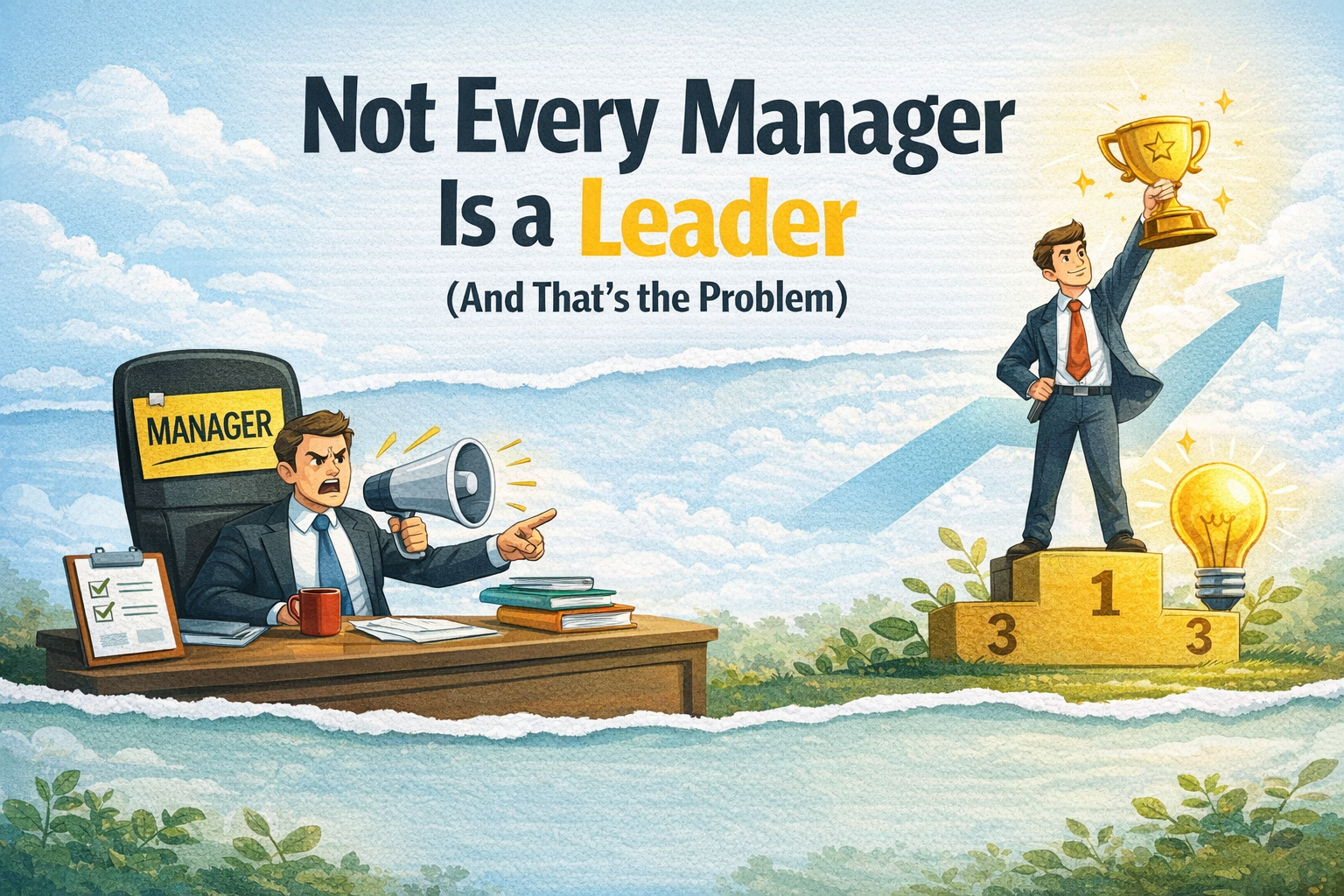
To set a definition for everyone, to me a manager tells you what to do, but a leader helps you understand why it matters and how to grow beyond it. A manager focuses on output and a leader focuses on development. A manager ensures work gets done but a leader ensures people get better. I hope you can see where I divide the terms, and I’m not saying that a manager is a bad thing.
Both roles exist for a reason, organizations need structure and they need coordination and accountability, but what we’ve done over time is elevate management as the default version of leadership, and in doing so, I think we’ve lowered the bar for what leadership actually looks like.
In my world having a title does not make someone a leader, and not having one doesn’t prevent someone from being one. I’ve had the luck at certain parts of my career to find leaders who weren’t event in my chain of command (so couldn’t call them leaders)…and that’s where mentorship comes in.
Mentorship is the clearest signal of leadership, and it doesn’t follow org charts. It doesn’t care about titles or reporting lines. It shows up in conversations, in guidance, in the way someone invests in another person’s growth without being asked to. Some of the best mentorship I’ve seen hasn’t come from people above me. It’s come from peers. It’s come from people earlier in their careers who had a different perspective, a different way of thinking, or simply the willingness to challenge assumptions. Leadership shows up wherever growth is happening.
That’s what makes it so different from management….”Management” is assigned….”Leadership” is demonstrated and when you start to look at teams through that lens, you begin to see something that’s a little uncomfortable…not everyone in a management role is leading, but that’s not always their fault.
A lot of managers are promoted because they were great analysts, then great engineers or strong individual contributors. They solved problems, they delivered results and they became the “obvious choice” when a leadership role opened up…and then we expect them to lead without ever really teaching them how.
We hand them responsibility for people and assume the skills will follow, we give them a new title and hope they figure it out, we measure them on output, not development and when things don’t go well, we quietly question their leadership instead of questioning the system that put them there without support…because being good at the work is not the same as being good at leading people doing the work.
I’ve had the luck a few times in my career, as I moved up the latter of having some people invest in me for leadership. I’ve been sent to some courses (some good, some just a seminar, and some I thought a waste of my time), but someone invested in me…not just promoted and left to my own devices. In my conversation with that colleague, I admitted I made some mistakes in my early managerial roles, I thought I was a leader (and to a degree I was one), but there was so much more I had to learn…and skills that took years to develop…and as I always am here…a lot a still have to learn…I’m not perfect. (but back to our problem)
Leadership requires a different mindset. It requires patience, it requires listening, it requires the ability to step back from doing the work yourself and instead help someone else grow into it. It requires understanding that your success is no longer defined by what you produce, but by what your team becomes and making sure they get that credit. That transition is not automatic or sometimes easy…and without support, most people default to what they know…They just manage.
They assign tasks, they track progress, they focus on delivery, they ensure things get done (that’s not inherently wrong) but those are necessary functions. Yet when that becomes the entirety of how someone operates, something important gets lost…Growth.
People don’t grow because they were told what to do, they grow because someone invested in them and someone took the time to explain, to challenge, to guide. All because someone saw potential and decided to develop it….That’s leadership. (it’s also where mentorship becomes the differentiator)
A leader mentors because they understand that their role is not just to get work done, but to build capability, a manager who doesn’t embrace that mindset will always operate at the surface level…tasks will be completed…deadlines will be met, but the team will remain dependent, waiting for direction instead of developing autonomy.
That difference compounds over time.
Teams led by managers stay functional.
Teams led by leaders evolve.
But there’s another side to this that we don’t talk about enough, and it’s just as important. Not everyone should be a leader (either not ready, or doesn’t want it)….and that’s okay.
Some people are exceptional individual contributors, they enjoy the work, they take pride in their craft, but they don’t want to manage people, navigate organizational dynamics, or be responsible for developing others…they just want to solve problems, build things, and go deep in their expertise. I took me longer than I would like to realize this.
We’ve created an environment where the only way to advance is to move into leadership roles, more responsibility, more people, more visibility and yes, more compensation…and that causes people to say yes. Not always because they’re ready. Not always because they want to lead. Sometimes because it feels like the next step. Sometimes because it’s expected. Sometimes because they’re chasing a raise….and that’s where things start to break.
Honesty side note, I’ve made this mistake, I took some promotions before I was ready just to chase the promotion latter, and I’ve done this to others to. Now each step I eventually rose to the needs of the role, but in retrospect I sometimes made the jump earlier than I should have…and stunted my growth or been immature in my role….I didn’t have the tool-set yet.
Because leadership isn’t something you can grow into passively. It requires intention. It requires self-awareness. It requires a willingness to shift how you define success. If someone (or you) isn’t ready for that shift, putting them in a leadership role doesn’t just impact them. It impacts everyone around them and this is where organizations play a critical role….Leaders shouldn’t be created out of necessity.
They shouldn’t be promoted just because a role needs to be filled. They shouldn’t be moved into positions of responsibility because they’re the most available or the most convenient choice…that’s how you end up with managers where you needed leaders.
Organizations need to be more deliberate, they need to support new leaders, not just appoint them. They need to provide guidance, mentorship, and development for the people stepping into those roles and they need to create paths for growth that don’t require leadership as the only option.
Because forcing someone into leadership rarely creates a leader, it creates someone trying to survive a role they weren’t prepared for and that’s not fair to them or their team. There’s also a responsibility on the individual side at some point, everyone has to ask themselves an honest question…Am I ready to lead? (and you need to be honest with yourself). Not “Do I deserve the promotion?” Not “Am I good at my job?” But “Am I ready to take responsibility for someone else’s growth?”…That’s a different question, and it requires a different kind of answer.
In my world, I think you can be an amazing analyst and get promoted to engineer or administrator fairly quickly. Yet when you get into the leadership latter and working your way up, each step you should spend more and more time on. For example, if you’re a good supervisor for 2 years (with mentor and leadership training) and get made a manager, then you should spend at least 4 years in management (with mentorship and training…blah) before looking for a director and working your way up. Unless you just want to be a manager…and leader takes time..and each step should take longer to really master that level.
We’re all guilty of looking at our boss at some point thinking they’ve got it easy, and some of us do the interim role where we see all the work that we never saw and the hard decisions they had to make (unless they were just a manager and delegated it all). Every level I’ve ever risen to has it’s own sets of challenges and things I needed to learn and master, it wasn’t just my job but more money…and those steps I needed to master before I was ready to move up.
Because leadership isn’t about authority, it’s about influence, it’s about creating an environment where people improve, where they feel supported, where they are challenged in the right ways, and where they leave better than they arrived…That doesn’t happen by accident and it doesn’t happen just because someone has a title.
The strongest leaders I’ve seen understand this instinctively. They don’t see their team as a list of resources. They see them as people with potential. They invest time. They ask questions. They listen more than they talk. They create space for others to grow, even when it would be faster to do the work themselves.
They mentor.
That mentorship doesn’t stop at hierarchy, it flows in all directions (Up, down, sideways), because leadership isn’t constrained by structure. It shows up wherever someone decides to help another person improve…that’s the shift we need to make.
We need to stop assuming that leadership comes with a title and start recognizing it as a behavior. We need to support managers in becoming leaders instead of expecting it to happen automatically. We need to create environments where mentorship is valued, not optional and we need to be more honest about readiness, both as individuals and as organizations.
Because at the end of the day, the difference is simple.
Managers create output.
Leaders create growth.
If we’re serious about building strong teams, resilient organizations, and meaningful careers, we have to start asking ourselves which one we’re actually developing, because having more managers won’t get us there…having more leaders might.